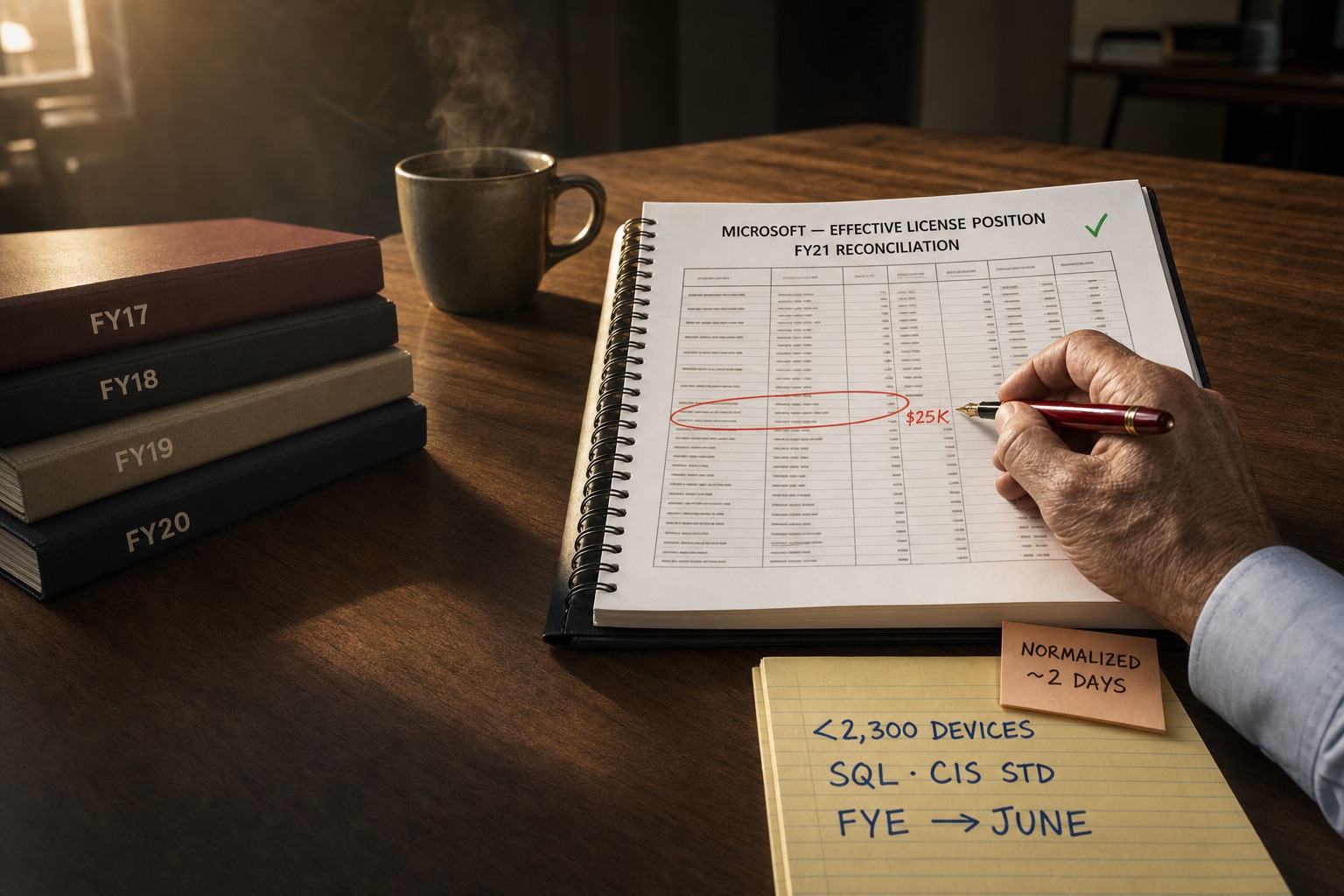
A regional consumer finance lender with a distributed branch footprint and a heavily virtualized Microsoft estate needed to get control of annual true-up decisions without slowing down operations. The problem was not a lack of data. It was the opposite. Licensing evidence lived in too many places: Microsoft License Statements, OEM records, full-package-product purchases, third-party software bundles, SCCM, MAP, and later virtualization extracts. Each source answered part of the question, but none of them gave leadership a reliable picture of what the company was entitled to use, what was actually deployed, and where the next renewal decision might create unnecessary spend or risk.
From 2017 through 2021, UMS supported repeated Microsoft license reconciliation, optimization, and normalization work for the lender. Over that span, UMS helped the client establish a baseline across an estate measured at 2,076 devices in one review and later estimated at less than 2,300 total devices globally, surfaced $25K in SQL hard-dollar exposure in the first major cycle, identified another $12.4K in Office and SQL exposure in a later review, modeled a $180K Microsoft licensing option, and formalized a fast normalization step to support future agreement decisions with cleaner data.
The result was not a one-time report. It was a repeatable Microsoft governance process that gave IT and procurement a shared fact base for true-up, renewal timing, and legacy cleanup.
The Challenge
The lender’s Microsoft environment had grown through normal business expansion, system changes, and renewal cycles that preserved old assumptions. That created four compounding issues:
- Fragmented entitlement evidence - Microsoft volume records were only one part of the picture. The client also needed OEM, full-package, appliance, and other supporting records to understand actual coverage.
- Recurring true-up pressure - Annual true-up and renewal decisions had to be made on schedule whether the internal team had perfect data or not. Without an independent reconciliation, the default path was to preserve historical quantities and hope nothing was missed.
- Legacy platform drag - The environment still included older Windows, Office, and SQL versions, including products already out of mainstream support. Those versions created both security concerns and licensing complexity.
- Misleading third-party assumptions - Some server products were widely assumed to include Microsoft licensing when they often did not. That is exactly the kind of gap that turns into surprise exposure later.
The internal team knew the environment operationally, but Microsoft licensing logic was not their full-time job. They needed a partner who could translate raw discovery outputs into a defensible Microsoft optimization and renewal posture.
How UMS Solved It
UMS approached the work as a multi-cycle operating program instead of a single snapshot.
Step 1: Build the first effective license position During the initial 2017 project, UMS used existing and no-cost tools including SCCM and MAP to inventory the estate, then pulled together Microsoft licensing detail from Microsoft, hardware vendors, full-package-product records, and third-party sources. The output was a reconciled Effective License Position designed to support the company’s year-two Microsoft true-up.
That first cycle established the basic pattern: do not treat Microsoft volume records alone as the answer, and do not let the renewal calendar outrun the facts.
Step 2: Turn findings into decision support Once the baseline existed, UMS moved beyond inventory. The engagement surfaced a $25K SQL hard-dollar exposure in the 2017 cycle and also supported evaluation of a Microsoft licensing scenario worth roughly $180K tied to SPE versus a blend of Office 365 and perpetual licensing. The point was not just to show gaps. It was to give the client a way to compare options before committing to them.
By the 2019 review, UMS was again helping the client understand Microsoft license position, gain control of the environment, and true-up correctly while identifying cost-saving opportunities. That review documented $12.4K in hard-dollar Office and SQL exposure and translated the reconciliation work into two operating paths: annual tactical baseline work or a more continuous License Management as a Service model.
Step 3: Use each annual cycle to improve the next one The later review cycles were not duplicates of the first. They deepened the operating model. In 2020, UMS documented guidance on Office 365 alignment, SQL core assignment timing, CIS Standard positioning, and Remote Desktop Services CAL considerations. One of the practical recommendations was to delay certain SQL Standard per-core purchases until after the true-up because the product was not yet in the EA, avoiding an unnecessary extra year of Software Assurance. UMS also advised using Microsoft’s supplemental price sheet process and timing negotiations against Microsoft’s June year-end leverage window.
The broader lesson: renewal posture is not only about how many licenses you need. It is also about when you buy, how you structure the order, and whether you are negotiating from current deployment evidence or inherited assumptions.
Step 4: Normalize the estate for repeatability By 2021, the engagement evolved into a normalization project intended to guide new Microsoft agreement decisions across an estate estimated at less than 2,300 devices, including desktops and servers, physical and virtual. UMS normalized installed-application data using customer-provided discovery sources including MAP and RVTools and produced an updated Microsoft-installed inventory report. The SOW targeted an approximately two-day delivery window.
That final step matters because recurring governance breaks when raw inventory data is inconsistent. Normalization made the next reconciliation faster, cleaner, and more defensible.
Results
| Metric | Before | After | Impact |
|---|---|---|---|
| License visibility | Entitlement and deployment evidence scattered across MLS, OEM, FPP, third-party records, and inventory tools | Reconciled ELP and later EDP / normalization outputs | Microsoft decisions tied to one working fact base |
| Hard-dollar exposure | Hidden inside SQL and Office deployment gaps | $25K SQL exposure surfaced in the first cycle and $12.4K Office + SQL exposure surfaced in a later review | Clear remediation priorities before audit or true-up |
| Renewal option analysis | Vendor proposals evaluated in isolation | $180K licensing scenario modeled and purchase timing guidance added to renewal planning | Better negotiating posture and fewer premature commitments |
| Inventory readiness | Ad hoc snapshots that degraded between cycles | 2021 normalization project for <2,300 devices completed in about 2 days | Faster turn for the next agreement cycle |
The most important outcome was operating discipline. UMS helped the client move from one-off reconciliation to a repeatable Microsoft governance rhythm: baseline the environment, reconcile entitlements, surface gaps, model purchase timing, and refresh the data before the next true-up window closes.
Key insight: Many Microsoft true-up problems are not caused by one catastrophic licensing mistake. They come from letting partially reconciled data roll forward from year to year until procurement is forced to make renewal decisions without a clean picture of the estate.
Additional Outcomes
- Legacy risk was made visible - UMS documented older Windows, Office, and SQL versions that were already out of support or approaching end of support, giving the client a concrete modernization backlog instead of vague technical debt.
- Third-party licensing assumptions were challenged - The reviews explicitly called out cases where bundled products were commonly assumed to include Microsoft rights when they generally did not, especially around SQL Server.
- IT and procurement got the same working dataset - Instead of debating abstract licensing rules, both teams could plan from the same reconciled evidence and contract negotiation context.
For enterprise teams with recurring Microsoft true-up obligations, this engagement shows a practical pattern. The highest-value work is often not dramatic one-time savings. It is building a process that prevents avoidable spend, keeps audit exposure from compounding, and lets the business negotiate from evidence instead of momentum.
That pattern is repeatable. Once the data is normalized and the reconciliation rhythm is established, each future cycle becomes less reactive and more strategic.